


Petroleum is, in many ways, the lifeblood of human civilization. It powers and lubricates the millions of engines that transport people around the world, it contributes to energy generation and it’s a key raw material behind an extraordinary assortment of products ranging from smartphones to false teeth. Unfortunately, obtaining the petroleum needed to do all these things is a tremendous technical and logistical challenge. Even after petroleum has been extracted from deep within the earth, there remains the problem of transporting it from the oilfield to its final destination.
In the rough-and-tumble early years, this was often accomplished by teamsters navigating their horse-drawn wagons over dusty trails and primitive roads, loaded down with rickety wooden barrels that leaked nearly as much petroleum as they stored. The industry has thankfully evolved in the intervening century and a half since Edwin Drake erected his first oil well outside Titusville, Pennsylvania in 1859, first with the rise of cross-country rail and then with the proliferation of oil tankers, trucks and massive oil pipelines. Still, transporting crude oil and petroleum products remains a difficult and occasionally dangerous proposition, and each of the modern methods offers advantages as well as pitfalls.
Rail Transport
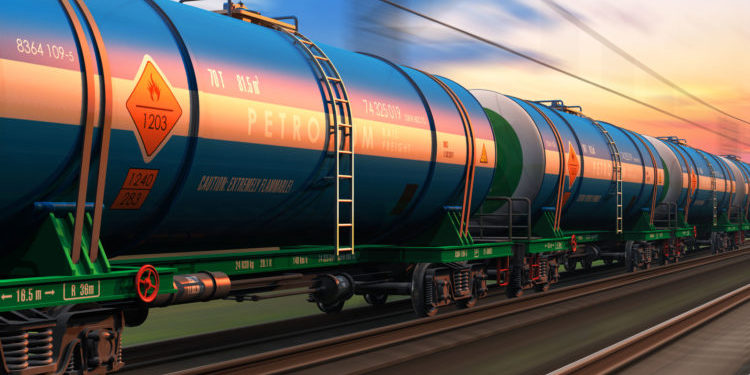
There’s a reason the humble train has been a popular choice in oil transport for more than a century and a half. Rail transport generally requires little new construction and far less initial cost than building a pipe system since most of the infrastructure is already in place. Rail transport is also relatively quick and efficient, and the volume of oil that can be carried has increased in recent years thanks to the use of larger trains and more tanker cars with each load. Additionally, while leaks and accidents may be more common than other transport methods, the total volume of oil lost in the average spill is far less than with other methods.
Unfortunately, that’s only half the picture. The other half is that transporting oil and petroleum products via train can be exceptionally dangerous. When things go wrong, a train carrying oil can very quickly turn into a bomb on rails. Explosions and raging fires have the capacity to claim lives and cause catastrophic damage, as was the case in the sleepy Quebec town of Lac-Mégantic. On July 6, 2013, a train carrying crude oil began to roll unattended down the tracks toward the town. It derailed near the downtown area, erupting into an explosive fireball that ultimately claimed 47 lives and destroyed dozens of surrounding buildings. Though Lac-Mégantic and other rail disasters helped to spur action toward improved safety regulations, train transport remains a potential danger to life and property.
Trucks
Compared to rail, trucks have one immediately obvious advantage: while trains are inherently limited in where they can travel, trucks are free to go virtually anywhere there’s a road to take them. This makes trucks a popular choice as not only an end-to-end transport option but also as an intermediary, hauling oil from its point of origin to a loading facility for tankers, barges or rail cars. Truck spills also tend to be less impactful by virtue of the fact that they carry a far smaller volume of oil than other methods, and spills generally happen away from vulnerable bodies of water.
However, as with driving any other vehicle, trucking is a dangerous business. Accidents are frequent, and trucks are often driven through vulnerable areas such as cities and busy highways. Additionally, since trucks can only carry a small volume, the number of trucks on the road must go up exponentially to keep pace. This creates an even higher accident risk, and it also takes a toll on local air quality and the environment. Though more stringent safety guidelines and a push for better driver training hold promise in making truck transport safer and more efficient, it will likely remain a small part of the solution moving forward.
Oil Tankers
When it comes to transporting oil and petroleum products, volume is king. This is the particular advantage of oil tankers, which can carry tens of millions of gallons vast distances across the globe. Compared to a few thousand gallons for the average truck, or a few million gallons for a large train, the tremendous capacity of a transoceanic tanker makes it a go-to choice for many applications. Even barges, which are often found on major rivers and their tributaries, can carry well over a million gallons.
Of course, all that volume can also become a major downfall in the event of a spill. Many of the largest oil spills in history have involved barges or tankers, resulting in massive and widespread environmental impacts on sensitive waterways and vulnerable coastal areas. Spills also come because of leaks or accidents involving smaller vessels, and while the volume is often small, the frequency of these events leads to a significant overall impact. Finally, barges and tankers can only be used to transport to and from facilities located near coastal waters or major river systems, meaning that other transport methods are often still needed to complete the journey.
Pipelines
Few topics have been more politically charged in recent years than oil pipelines. In fact, a contentious battle is currently ongoing over a proposed line that would transport oil from the booming Bakken oilfield through the Midwest to a distribution point in south-central Illinois. Supporters argue, correctly, that there are several benefits to such a development. Transporting oil by pipe is far safer than other methods, often quicker and requires less upkeep cost after the initial investment in construction. Well over half of all oil in the United States already flows by pipe, and that number may only increase if recently proposed developments are given the go-ahead.
However, it’s far from a perfect method. Pipes wear and corrode over time, and inadequate observation and maintenance have led to several destructive, high-profile leaks in recent years. In 2010, the largest inland oil spill in American history occurred when a pipe ruptured in southern Michigan, sending up to a million gallons of oil rushing into a tributary of the Kalamazoo River. Other spills have occurred more slowly, as older pipes fall into disuse and any remaining oil seeps out over time. There may be a reason for optimism, however, as the government and other oversight agencies have begun to push for tighter regulations and more accountability from oil companies. New technologies also offer hope, including innovative pieces of gear called smart pigs. These sleek machines travel the length of a pipe, using highly-tuned sensors to detect corrosion, weaknesses and other defects that could cause problems in the future.
Transporting oil has always been a difficult, expensive and often dangerous affair. That isn’t likely to change soon, but neither is the ever-increasing demand for more of the viscous liquid that powers the modern world. Instead, it falls to a combination of improved oversight, better technology and innovative new ideas to make the process as safe and efficient as possible. If recent events are any indication, there’s still plenty of work to be done.


Please I need your urgent assistant.
What is the Oil and Gas Logistics PROS and CONS..